Remembering the last five British-trained winners of the Grand National
 The Grand National at Aintree is one of the most iconic horse races in the world, and it holds a special place in the hearts of British racing fans and punters. For those interested in horse racing betting, the National is a marquee event, offering the excitement of long odds, unexpected victories, and epic comebacks that have made legends out of both horses and jockeys.
While Irish-trained runners have dominated the recent history of the Grand National, British-trained horses have still managed to leave their mark with some memorable wins in the past decade. Let’s take a look back at the last five British-trained horses who seized victory at Aintree.
1. Corach Rambler (2023)
The most recent British-trained winner, Corach Rambler, stormed to victory in 2023 under the expert guidance of Lucinda Russell. This was Russell’s second Grand National win, having previously triumphed with One For Arthur in 2017.
Corach Rambler’s thrilling run showed a combination of stamina and grit, proving that the spirit of British racing is still very much alive. Piloted by jockey Derek Fox, Corach Rambler was a popular choice among punters, securing his place in Grand National winner history with a convincing victory for Vanillier.
2. One For Arthur (2017)
One For Arthur’s 2017 victory was a momentous one for Russell, as it made him only the second Scottish-trained horse to win the Grand National. Also ridden by Fox, he executed a perfectly paced run to overcome heavy competition, crossing the line with a strong finish.
The then eight-year-old was one of several horses in contention at the last fence but stayed on better than his challengers for an almost five-length victory over the Irish-trained Cause Of Causes.
3. Many Clouds (2015)
The 2015 Grand National winner, Many Clouds, was trained by Oliver Sherwood and ridden by jockey Leighton Aspell. Many Clouds was a remarkable horse with a career full of high points, and his Grand National win is one of the most memorable.
Aspell’s skilful navigation helped Many Clouds surge ahead of the field, finishing with an impressive 1¾ lengths ahead of Saint Are. His victory was doubly significant as it marked Aspell’s second consecutive win, having ridden the Irish-trained Pineau De Re to success in 2014.
Sadly, Many Clouds passed away at just 10 in 2017, but his Grand National legacy remains intact.
4. Pineau De Re (2014)
Pineau De Re, trained by Dr. Richard Newland, took the 2014 Grand National by storm. Although he was born in France, he was British-trained, and his win was celebrated as a triumph for British racing.
Ridden by Aspell, who had retired from the sport in 2007 only to return two years later and ultimately achieve Grand National glory on two occasions. Pineau De Re finished the race by an impressive five-length margin.
5. Auroras Encore (2013)
Auroras Encore’s victory in the 2013 Grand National remains one of the most surprising upsets in recent memory. Trained by Sue Smith, he defied odds of 66/1 to claim victory, proving that anything can happen in the Grand National.
Jockey Ryan Mania, making his debut in the race, rode Auroras Encore to an incredible finish, winning by nine lengths ahead of the field. Smith’s training skill and Mania’s incredible first-time performance highlighted the unpredictable excitement of the Grand National.
Related: a list of Grand National Winners of the 1980s
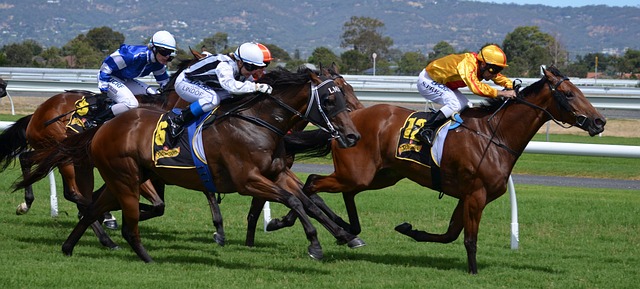 Not to be confused with the Queen Elizabeth II Stakes, or ‘QEII’ – which is, in fact, the most prestigious and valuable mile race in Europe – the Queen Elizabeth II Jubilee Stakes is likewise a Group 1 race run at Ascot, but over six furlongs on the fifth and final day of Royal Ascot in June each year. The race was inaugurated, as the All-Aged Stakes, in 1868 and, since being promoted to Group 1 status in 2002, has been run under various titles in commemoration of the Golden, Diamond and Platinum Jubilee of the late Queen Elizabeth II. In 2023, the iconic sprint was renamed to its current title to honour Her Late Majesty in perpetuity.
 Boasting total prize money in excess of £1.5 million, of which winning connections collect over £882,000, the Derby is the most valuable and prestigious race run in Britain. Nowadays run on the first Saturday in June, over a mile and a half, on a left-handed, famously switchback course at Epsom Downs, the second jewel of the traditional Triple Crown has, inevitably, become the yardstick by which colts of the Classic generation are measured. Indeed, even in modern times, it is worth noting that the likes of Sea Bird, Mill Reef, Sea The Stars, Shergar, Generous and Reference Point, all of whom feature in the top twenty highest-rated horses of the Timeform era, which began in 1948, all won the Derby.
 The running of the Blue Riband event of the Cheltenham Festival, the Cheltenham Gold Cup, is always a memorable. However, the 1989 renewal was particularly noteworthy for arguably the greatest achievement in the 70-race career of the popular, front-running grey Desert Orchid. “Dessie”, as he was affectionately known, arrived at Cheltenham on March 16, 1989 unbeaten in six races since a five-length defeat by Pearlyman in the Queen Mother Champion Chase at the previous Cheltenham Festival.